
Plantation, FL
Pool Service in Plantation, FL
Weekly pool care across Plantation, from the acre lots out in Plantation Acres to the canal blocks around Plantation Gardens and Jacaranda.
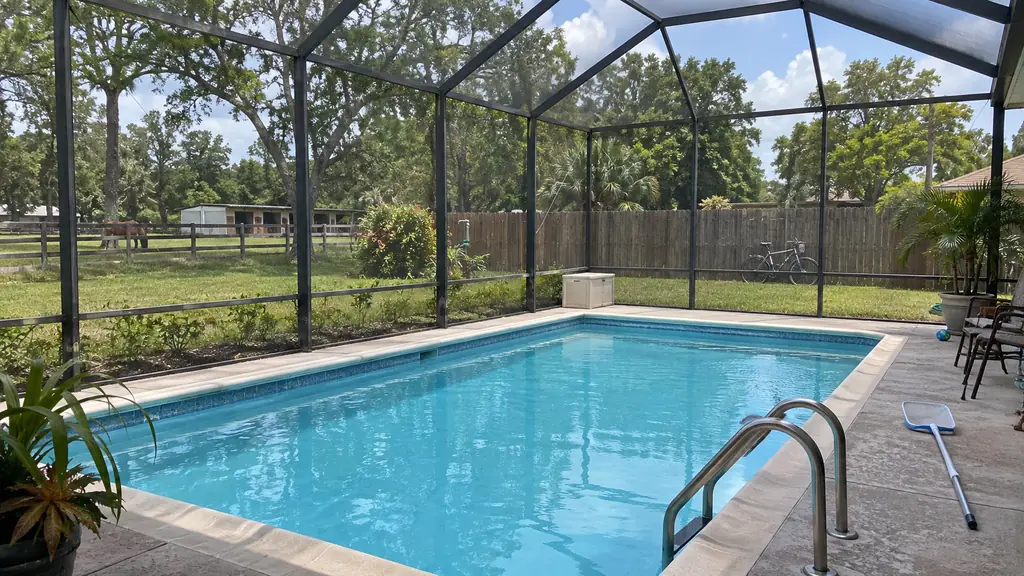
A backyard swimming pool at a home in Plantation, FLLocal conditions
What actually affects a pool in Plantation.
An oak dropping onto the water again before the week is out, a District-owned canal behind the fence line holding onto whatever reaches it. Two things about a Plantation back yard are not the homeowner's to change, and both of them land on the pool.
The first is the canal. The Old Plantation Water Control District was created by the state legislature in November 1946 and runs about 36 miles of waterway and four major pumping stations inside the city. The District owns the canals and the strip of ground beside them, so where a yard ends at water, the last few feet belong to the District and nothing may be built on them. The system is close to closed: the pumps discharge only when there is excess stormwater, which is the District's own reason for warning that whatever goes into a canal tends to stay in the neighborhood for a long time.
The second is the canopy. Plantation has been a Tree City USA for more than forty years, most recently in 2025, and it backs that up with a permit regime. Taking down a healthy tree requires a certified arborist's report justifying the removal, and any tree that does come out has to be replaced at a minimum of twelve feet. Which means the oak dropping into the pool is, in practical terms, a permanent feature of the property. The debris load is a condition to be managed, not something to be landscaped away.
- Mature canopy across most of the city, protected by an ordinance strict enough that a healthy tree needs an arborist's report before it can be removed.
- Around 36 miles of District canal running behind a large share of the houses, bringing a steady organic load and wildlife traffic to the yards that back onto it.
- A drainage system that only discharges during storms, so nutrients that reach the canal stay in it. The District's own answer to the weed growth that follows is grass carp and mechanical harvesting.
- An inland position with no coastline, which keeps salt off the equipment entirely. Fort Lauderdale sits between Plantation and the ocean, and just over one percent of the city's area is water.
- Roughly 67 inches of rain a year, concentrated in a wet season running from about mid-May to mid-October.
- Acre-and-up lots in the west of the city, where bigger yards mean bigger pools, longer equipment runs and more landscaping within reach of the water.
Every visit
What weekly service covers in Plantation.
The pool sets the priorities. An acre lot in Plantation Acres under heavy canopy and a lakefront pool in Jacaranda Lakes are not the same job. Across regular service, that work covers:
- Chlorine and pH balancing, read against the week's heat, rainfall and how much the pool has been used.
- Brushing walls, steps and benches, where algae takes hold before the water gives anything away.
- Vacuuming scaled to what has actually settled, which under this much canopy is the part of the job that varies most week to week.
- Waterline tile cleaning, adjusted for plaster, stone or glass finishes.
- Clearing skimmer and pump baskets, which fill faster here than almost anything else on a route.
- Filter pressure checks, with a backwash or a cleaning when the reading calls for it.
- Inspecting the pump, filter, heater, salt cell and automation at the equipment pad.
- Watching the water level and the shell for the early signs of a structural problem.
Routine balancing chemicals are included unless the approved quote says otherwise. You get a written report after every visit with your readings, what was handled and a photo.
Cost
What pool service costs in Plantation.
Weekly pool care starts at $95 a month. Most standard residential pools land between $95 and $189, and the exact figure is confirmed before service begins, so the price you approve is the price you pay.
Three things move the number:
- The size of the pool, measured from satellite imagery rather than estimated.
- How much tree cover sits over the water.
- Whether there is a sun shelf or tanning ledge.
Give it an address and the real number for your pool comes back in about a minute.
Neighborhoods
Neighborhoods and pool types across Plantation.
The city was laid out in stages from the 1950s westward, and the stage a neighborhood belongs to tells you most of what its pools need.
Plantation Acres
The acreage district in the west, between Hiatus Road and Flamingo Road north of State Road 84, and one of the largest communities in the city. Lots run up to three acres, most of it without an HOA, with horse-keeping and the city's equestrian center at Volunteer Park nearby. Bigger lots mean bigger pools, longer runs between the pad and the water, and a great deal more landscaping in range of the surface.
Plantation Gardens and Plantation Park
The older east side, between Sunrise and Broward Boulevards. Plantation Gardens was built mostly between 1956 and 1972 and Plantation Park dates from 1958, so these are among the oldest pools in the city. Sixty-plus years of growth around them, single-family lots without a mandatory HOA, and surfaces and plumbing that have usually been through more than one repair.
Jacaranda and Jacaranda Lakes
Central and west, dating to 1972, with Jacaranda Lakes built in phases between 1978 and 1995 south of Sunrise Boulevard. About half of those homes look onto water and there are canals through the community, so surface load is constant and circulation matters more than heavy dosing. Most of these homes have a pool.
Melaleuca Isles, Waterway Estates and the southwest
Built between roughly 1965 and 1980, on standard suburban lots of an acre or less. Waterway Estates went up almost entirely between 1971 and 1973, so a whole street's worth of equipment tends to reach the end of its life at the same time. Pools here are a generation younger than the east side and a generation older than the west.
Canal lots and interior lots
The sharpest split in the city, and it is a legal one as much as a physical one. A canal lot carries a District easement: the ground is the homeowner's to maintain but not to build on, so fences, sheds and equipment cannot sit there. It also takes a steady organic load off open water. An interior lot is simpler to work on and simpler to read, and usually takes its debris from directly overhead instead.
Repairs and equipment
Repairs, equipment and leak detection in Plantation.
Nothing out here is fighting salt air, so pumps, heaters and cabinets get an easier life than they would ten miles east. What they fight instead is volume. Heavy organic load means baskets and filters work harder and impellers clog more often, and a system that is always slightly behind on flow is a system whose pump is running hotter and longer than it was specified for. Most of the equipment failures on a canopy lot start as a circulation problem, not an electrical one.
Water loss is worth reading carefully on a canal lot. Rain, evaporation and a sprinkler zone aimed the wrong way can all look like a leak, and a genuine leak can hide underneath a rainy week. Leak detection starts with an inspection and a diagnosis, and the pricing is confirmed before any repair work begins. Where the work sits near a canal, there is a second question worth settling first, which is where the District's ground actually starts.
Worth a call before it turns into a repair:
- Filter pressure climbing back up within days of a backwash rather than weeks.
- A pump straining, running hot or losing prime, usually a basket or an impeller packed with debris.
- The water level dropping faster than a hot dry week on its own explains.
- Persistent staining under the debris line, where leaf tannin has been sitting on the surface.
- Ground that stays soft or damp near the equipment pad, the deck or the pool shell.
- Water that will not clear no matter how the chemistry is adjusted.
Questions
Common questions in Plantation.
Weekly, and the canopy is the reason. Leaf and seed drop here is steady all year rather than seasonal, so skimmer baskets and filters fill faster than they do in newer, more open suburbs. A two-week gap is usually long enough for the debris load to overwhelm circulation, and once flow drops the chemistry follows.
It starts at $95 a month, and most standard residential pools land between $95 and $189. Pool size is the biggest factor, then tree cover and whether the pool has a sun shelf. Tree cover matters more here than in most of Broward, which is worth knowing before comparing a Plantation price against one from a newer, more open neighborhood. Routine balancing chemicals are included, and the exact figure is confirmed before service begins.
No. Service is month to month, with no term to sign.
Not freely. Plantation requires a permit to remove or relocate a tree, and for a healthy one that means a certified arborist's report justifying it, with a replacement tree required at a minimum of twelve feet. Trimming has its own permit. Worth checking with the city before planning any of it, because for most owners the realistic answer is managing the debris rather than removing the source.
It adds a steady organic load to the surface and it puts a District easement across the back of the property. The ground beside the canal belongs to the Water Control District, so fences, sheds and equipment are not permitted on it, which is worth knowing before siting anything new near the water. It does not change the price on its own. Pool size and condition drive that.
More than it does in an open neighborhood, because a storm brings down a season's worth of canopy at once. Heavy rain dilutes the chemistry at the same time, and a pool left that way turns green quickly in Florida heat. Storm cleanup beyond the normal weekly visit is quoted separately, based on what the pool actually needs once the weather clears.
Routes run from Plantation Acres in the west across to the older neighborhoods either side of Broward Boulevard and University Drive. Plantation Acres, Jacaranda, Jacaranda Lakes, Plantation Gardens, Plantation Park, Plantation Isles, Melaleuca Isles, Waterway Estates and Lauderdale West are all inside the area served. Service is route-based, so the exact street still decides it, and the fastest way to know is to enter the address.
Nearby: pool service in Fort Lauderdale, pool service in Sunrise, pool service in Davie. See every service area.
Ready to enjoy the Blu in Plantation?
Enter your address and get an answer in seconds.
Fully insured for residential pool service.