
Fort Lauderdale, FL
Pool Service in Fort Lauderdale, FL
Weekly pool care across Fort Lauderdale, from the dredged isles off Las Olas to the older blocks around Victoria Park and the New River.
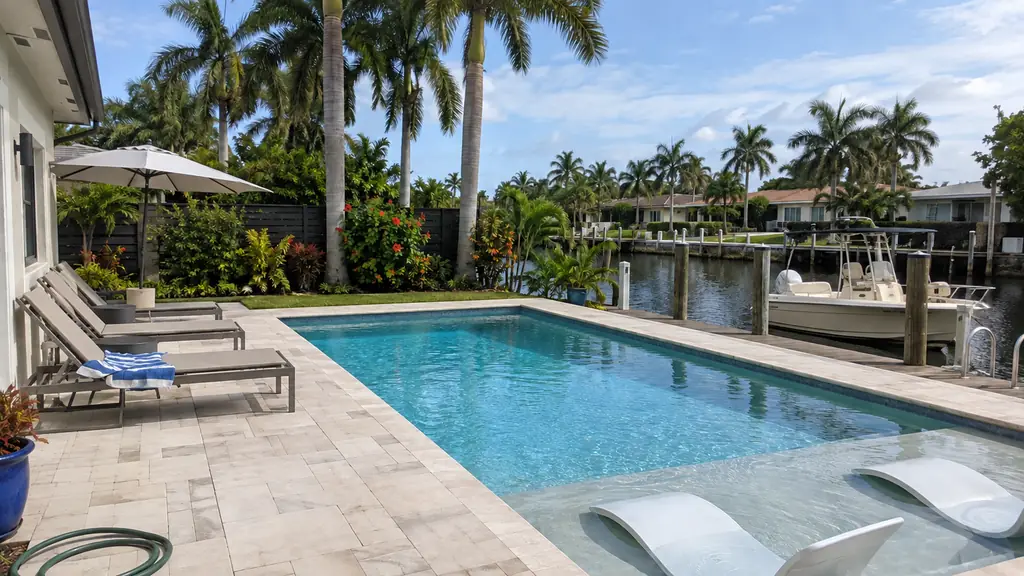
A backyard swimming pool at a home in Fort Lauderdale, FLLocal conditions
What actually affects a pool in Fort Lauderdale.
Tidal water pressing against a seawall a few feet from the equipment pad, salt riding in on the breeze off Port Everglades, a king tide backing against the valves before a drop of rain falls. Fort Lauderdale has water where most cities have back yards. The city puts the figure at 165 miles of inland waterway inside roughly 36 square miles, and close to five percent of everything within the city limits is surface water. A good share of it was dug rather than found. The isles off Las Olas were cut out of wetland in the 1920s using a technique the developers called finger islanding, borrowed from Venice, which is where the Venice of America tag on the city's own website comes from.
That matters for a pool because the water in those canals is not fresh. The New River is a tidal estuary that meets the Atlantic at the Port Everglades cut, and the whole network moves with the tide. The city runs around 215 tidal valves to stop salt water backing up into the streets on a king tide, and it expects at least forty of those days in 2026. So on a canal lot the salt is not only arriving on the breeze. It is sitting a few feet from the equipment pad.
The other half of the story is age. About sixty percent of the housing here went up between 1950 and 1979, and barely four percent of it predates 1950. Pools that old have been through several sets of equipment, and the ones on the eastern waterfront have been doing it with salt water on the other side of the seawall.
- Tidal salt water in the canal network, connected to the Atlantic at the Port Everglades cut and rising and falling twice a day.
- Airborne chloride along the waterfront, which is hygroscopic, so deposited salt keeps metal damp long after the weather has dried everything else. It is why coastal corrosion outruns what the rainfall alone would suggest.
- King tides on at least forty days in 2026, mostly between September and December, with the city naming Victoria Park, the Southeast Isles and Middle River Terrace among the areas that take the water.
- Seawall lots where the pool, the deck and the equipment pad all sit within a few feet of open water.
- Mature canopy through the older inland neighborhoods, where leaf and seed drop on an open pool runs steadily rather than in seasons.
- A wet season from roughly mid-May to mid-October, when rain dilutes chemistry and pushes yard runoff toward the water.
Every visit
What weekly service covers in Fort Lauderdale.
The pool sets the priorities. A seawall pool on one of the Las Olas isles and a shaded pool in Sailboat Bend are not the same job. Across regular service, that work covers:
- Chlorine and pH balancing, read against the week's heat, rainfall and how much the pool has been used.
- Brushing walls, steps and benches, where algae takes hold before the water gives anything away.
- Vacuuming scaled to what has settled, which runs heavier under the older canopy inland than it does out on the isles.
- Waterline tile cleaning, adjusted for plaster, stone or glass finishes.
- Clearing skimmer and pump baskets so circulation keeps up with what blows in off the canal.
- Filter pressure checks, with a backwash or a cleaning when the reading calls for it.
- Inspecting the pump, filter, heater, salt cell and automation at the equipment pad, which on a seawall lot is the part of the system the salt reaches first.
- Watching the water level and the shell for the early signs of a structural problem.
Routine balancing chemicals are included unless the approved quote says otherwise. You get a written report after every visit with your readings, what was handled and a photo.
Cost
What pool service costs in Fort Lauderdale.
Weekly pool care starts at $95 a month. Most standard residential pools land between $95 and $189, and the exact figure is confirmed before service begins, so the price you approve is the price you pay.
Three things move the number:
- The size of the pool, measured from satellite imagery rather than estimated.
- How much tree cover sits over the water.
- Whether there is a sun shelf or tanning ledge.
Give it an address and the real number for your pool comes back in about a minute.
Neighborhoods
Neighborhoods and pool types across Fort Lauderdale.
A pool on a dredged isle and a pool six blocks inland are in the same city and not in the same conditions. These are the patterns that decide what each one needs.
Las Olas Isles, Seven Isles and Nurmi Isles
Cut out of wetland in the 1920s, so nearly every lot is a narrow peninsula with a seawall and tidal water on one side or both. The pool, the deck and the pad are all inside a few feet of salt water, which is why rails, ladder bolts, screen fixings, light rings and heater cabinets wear here in a way they do not further inland.
Rio Vista and the Southeast Isles
Rio Vista had its sidewalks and streetlights in by February 1923, and the stock runs to Spanish and Mediterranean Revival with contemporary infill. Canal and Intracoastal frontage with private docks is the norm. The city names the Southeast Isles among the areas with significant tidal impact, so water level and ground conditions around the deck are worth reading carefully here.
Coral Ridge and the northeast waterfront
Built out after the Second World War by Coral Ridge Properties, whose yacht club was conceived in 1947 and had 450 members by 1951. The Landings followed nearby starting in 1960, developed by the same Haft-Gaines partnership behind Imperial Point, with the first homes opening in 1962. Wide deep-water canals, many with no fixed bridges to the ocean. The pools are mid-century and usually several sets of equipment deep.
Victoria Park, Sailboat Bend and the older inland blocks
Victoria Park holds 494 of the 1,748 residential buildings in the city that predate 1945 and are still standing. Sailboat Bend is a local historic district with stock from the early 1900s through the 1950s. Smaller lots, heavier canopy, older surfaces and original plumbing runs, so the weekly visit is as much about catching wear as about clarity.
Imperial Point and the inland north
Haft-Gaines built this in two phases, 1960 to 1963 and 1963 to 1967, on an inland tract of pine and palmetto scrubland around a freshwater pond. No seawall means the equipment gets an easier life than it does on the water. What these pools have instead is age and tree cover.
Repairs and equipment
Repairs, equipment and leak detection in Fort Lauderdale.
Salt does the work here that age does inland. The international corrosivity scale puts sheltered positions on a coastline in its second-highest category, and the mechanism is not complicated: chloride settles on metal, chloride holds water, and metal that stays damp corrodes for more hours of the day than the weather alone would account for. On a seawall lot that reaches the pump housing, the heater cabinet, rail anchors, ladder bolts, screen fixings and light rings.
Age does the rest. With sixty percent of the city's housing built between 1950 and 1979, a typical pool here is several equipment generations in, with plumbing that has been patched rather than replaced. Water loss is harder to read against a tidal canal too, where the level on the other side of the seawall moves twice a day. Leak detection starts with an inspection and a diagnosis, and the pricing is confirmed before any repair work begins.
Worth a call before it turns into a repair:
- Rust bleeding from a rail anchor, a light ring or a screen fixing.
- Corrosion or white crust building on the equipment pad, particularly around the heater cabinet.
- The water level dropping faster than a hot dry week on its own explains.
- Air at the return jets, or a pump that keeps losing prime.
- Ground that stays soft or damp between the pool and the seawall.
- Water that will not clear no matter how the chemistry is adjusted.
Questions
Common questions in Fort Lauderdale.
Weekly is the right baseline here. Between the wet season diluting chemistry, the dry season burning off chlorine and the organic load blowing in off the canals, a two-week gap is usually long enough for water to move out of balance and for algae to get a start. On a seawall lot there is a second reason: the equipment is worth looking at more often than the water is.
It starts at $95 a month, and most standard residential pools land between $95 and $189. Pool size is the biggest factor, then tree cover and whether the pool has a sun shelf. Routine balancing chemicals are included, and the exact figure is confirmed before service begins, so the price you approve is the price you pay.
No. Service is month to month, with no term to sign.
It shortens the life of the metal. Chloride settles on surfaces and holds moisture there, so pump housings, heater cabinets, rails, ladder bolts, screen fixings and light rings all sit wet for longer than the weather alone would leave them. The pump and filter internals are not the issue. The cabinets, fasteners and fittings around them are, which is why the equipment pad gets looked at every visit on a waterfront lot.
Because the canal is tidal and the water table beside it moves with it. Rain, evaporation, a sprinkler zone aimed the wrong way and a high tide can all look like a leak, and a real leak can hide underneath a rainy week. Reading it properly takes a set of measurements rather than one look, which is where leak detection starts.
Heavy rain dilutes the chemistry and pushes yard debris and runoff into the water, and on a low-lying lot a king tide can put the canal into the equation as well. A pool left that way turns green quickly in Florida heat. Storm cleanup beyond the normal weekly visit is quoted separately, based on what the pool actually needs once the weather clears.
Routes run from the isles off Las Olas Boulevard and the Southeast Isles north along the Intracoastal, and inland through the older blocks either side of Sunrise Boulevard. Victoria Park, Rio Vista, Coral Ridge, The Landings, Imperial Point, Sailboat Bend, Lake Ridge and the Las Olas isles are all inside the area served. Service is route-based, so the exact street still decides it, and the fastest way to know is to enter the address.
Nearby: pool service in Pompano Beach, pool service in Plantation. See every service area.
Ready to enjoy the Blu in Fort Lauderdale?
Enter your address and get an answer in seconds.
Fully insured for residential pool service.